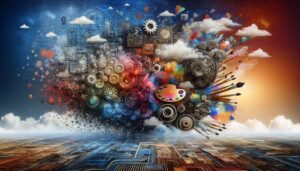
Hey tech enthusiasts! It seems like every time I blink, there’s a new AI breakthrough that’s shaking up the world. Well, today’s topic is no different: the impact of Artificial Intelligence on the creative arts. As someone who’s followed the tech world for years, I’ve got to say that this is one of the most fascinating developments I’ve seen in a while. Imagine machines co-authoring a novel with you or helping you paint like Van Gogh but with your unique twist. Trust me; this is one rabbit hole you’ll want to go down.
A New Palette: AI Enters the Creative World
The intersection of AI and creative arts isn’t just a blip on the radar. It’s a phenomenon that’s rocketing forward with turbo boosters on. We’re not just talking about AI-generated memes or funky apps that create fantastical selfies (though let’s be honest, those are fun too). No, I’m talking about AI contributing to serious creative work—whether it’s composing symphonies, generating digital art, or writing scripts.
Take, for instance, OpenAI’s GPT models. They’re like tiny multi-talented muses that can whip up prose in the blink of an eye. I sometimes joke that GPT-3 is a better writer than I am, and I have the existential crises to prove it! It’s incredible to think how these models take a thousand different ideas and weave them into something coherent, even thought-provoking.
Machines with a Brush: AI in Visual Arts
How many would’ve thought that someday we’d have a machine generating fine art that museums might consider displaying? AI-based platforms like DeepArt and Runway ML use neural networks that are trained on vast collections of artwork to create paintings in various styles. Just last year, a portrait generated by AI was auctioned off at Christie’s for over 400,000 dollars. Let that sink in for a moment.
The coolest part? Artists aren’t out of a job—far from it. They’re collaborating with these digital partners, using AI to enhance their own creativity. This collaboration is opening new doors, allowing for hybrid art forms that were previously unimaginable. So, if your next abstract landscape ends up looking like a cross between Monet and Mondrian, you might have your AI partner to thank (or tease).
Soundtrack of the Future: AI in Music Composition
Let’s not forget music, the art form that speaks directly to the soul. With platforms like Aiva and Amper Music, AI is not just generating melodies—it’s crafting entire compositions! Movie directors and content creators are turning to these tools for custom soundtracks that would make Mozart nod in approval.
Back in the day, producing high-quality music required access to expensive recording studios and a group of talented musicians. Now? A smart AI can simulate entire orchestras, making high-quality music creation accessible to just about anyone with a laptop. Music has always been democratizing, and AI is taking it to the next level.
The Writer’s Room: AI in Storytelling
Ever get writer’s block? You’re not alone. But now, AI assistants like Sudowrite help authors break through that creative wall. It’s like having an infinite number of brainstorming sessions at your fingertips.
But let’s get one thing straight: AI isn’t going to replace authors. The beauty of storytelling lies in its ability to convey human experience, emotions, and nuances which are—at least for now—best captured by human writers. Instead, think of AI as a Swiss Army knife for your imagination, sharpening and enhancing your narrative with suggestions you hadn’t considered.
Dancing with Robots: AI in Performing Arts
This is where things get truly sci-fi. The performing arts are experiencing an interesting AI infusion as well. In recent months, I’ve seen robots choreograph dance routines and perform on stages once occupied solely by humans.
Although robots don’t exactly have grace written into their code just yet, there’s something mesmerizing about their ability to execute routines with pinpoint precision. Human dancers now have new digital partners, and let me tell you, the possibilities—of precision, coordination, and even creativity—are endless.
The Inevitable Debate: Creativity’s Human Element
Of course, with great power comes great scrutiny. Critics argue that AI lacks the emotional depth or intuition that fuels genuine creativity. Sure, AI can create art, but can a machine really understand heartbreak or joy? These aspects are so integral to the best works of art.
In my opinion, a neat middle ground exists. AI doesn’t need to replace the human touch; it can be a valuable tool for artists, opening up possibilities for what they can achieve. The partnership between human creativity and AI-enhanced tools could lead to art forms we’ve never dreamed of before—art that touches hearts with the same intensity and beauty as that of its purely human predecessors.
What’s Next? Future Outlook
If there’s anything I’ve learned, it’s that predicting the future feels like trying to guess what your cat is plotting when it gives you that side-eye. What’s clear, though, is that AI’s role in the creative arts will only grow. Future innovations may include AI personalities that you’d consider collaborating with, or better yet, AI technology that customizes artwork to connect deeply with individual viewers.
We’re just at the dawn of this unexplored world, and I, for one, am thrilled to see where it leads. AI in the arts won’t just change how art is produced; it’ll change how we engage with it, how we discuss it, and perhaps even how we define it.
Thanks for joining me today on this ride through the world of AI in creative arts. The canvas is blank, the AI palettes ready—and the creations promise to be fascinating. Until next time, keep creating, keep exploring, and let’s see where this wave of technological wonder takes us.
