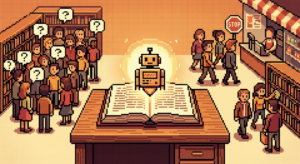
The short version: this matters more than the headline suggests.

I Cannot Stop Thinking About This
There are topics I write about because they matter to the industry, and then there are topics I write about because I cannot stop thinking about them. This falls into the second category. Romance fiction has always thrived on intimacy, authenticity, and the unspoken promise that a human heart poured something genuine onto the page. Now, that promise is being renegotiated in real time, and the Romance Writers of America has decided it is time to put some rules on paper.
The pattern here is familiar once you’ve seen it a few times. The evidence here is worth examining carefully.
In September 2025, the RWA published its first formal AI Ethics and Disclosure Guidelines. The organization recommends that any novel with AI assistance carry a standardized label on its copyright page and in its product descriptions online. It is not a ban. It is not a punishment. It is, at its core, a request for honesty. But the response from authors, readers, and competing organizations has been anything but quiet.
The Disclosure Gap Is Real and It Is Wide
Here is the number that stopped me cold. A membership survey conducted by the RWA in 2025 found that more than half of its 9,000-plus members had used AI tools at some point in their writing process. Over half. Yet only about one in eight of those authors had voluntarily told their readers. The gap between usage and disclosure is not a rounding error. It is a canyon.
Authors have plenty of reasons for staying quiet. Some worry that disclosure will invite unfair judgment before a reader ever opens the book. Others argue that using AI for brainstorming or editing is no different from using Grammarly or hiring a developmental editor. These are reasonable points. But reasonable points do not change what readers actually want to know.
The Pew Research Center AI and Media Consumption Report found that 67 percent of fiction readers want to know whether a book involved AI assistance before they hand over their money. That is a clear majority expressing a clear preference. Interestingly, only 29 percent said that disclosure would actually stop them from buying. Readers are not asking for a scarlet letter. They are asking for a label, the same way they want to know if a product contains nuts or was made with recycled materials.
What the RWA Guidelines Actually Say
The Romance Writers of America Official Guidelines take a measured approach. Rather than defining exactly how much AI involvement crosses a line, they focus on transparency as a value. The recommended label is meant to appear in two places: the copyright page inside the book and the product description wherever the book is sold. The goal is to give readers the information before the purchase, not buried in fine print they will never find.
The guidelines also emphasize that AI disclosure does not automatically say anything negative about a book’s quality. The RWA is not declaring AI-assisted romance to be lesser romance. What the organization is saying is that readers deserve to make informed choices and that the long-term health of the genre depends on trust between authors and audiences. It is a pragmatic position, and for a genre that has spent decades fighting for its literary credibility, pragmatism over panic is worth noting.
The guidelines do not carry legal force. An author who ignores them faces no formal penalty from the RWA itself. But the reputational stakes are real, especially in a genre where reader communities are vocal, organized, and deeply loyal to authors they feel have been straight with them.
How the Rest of the Publishing World Is Responding
The romance community does not exist in a vacuum, and the AI debate is raging across every corner of genre fiction. The Science Fiction and Fantasy Writers Association moved faster and harder than the RWA in 2025, adopting a policy that disqualifies any work containing more than 25 percent AI-generated content from award eligibility. That is a specific, measurable threshold. It sparked immediate debate about how anyone could possibly verify such a percentage and whether 24 percent is meaningfully different from 26 percent.
The cross-genre friction has been productive even when it has been uncomfortable. Romance authors have watched the SFWA debate and largely concluded that hard percentage cutoffs are difficult to enforce and may punish legitimate creative uses of AI tools. The RWA’s softer, disclosure-focused approach reflects that skepticism. Whether softer guidelines will actually change author behavior is the open question.
Publishers, for their part, are moving cautiously. Several major houses have begun requiring AI disclosure clauses in new contracts, but enforcement and definitions vary widely. The industry is writing rules for a technology that is still changing shape beneath everyone’s feet.
The Star Rating Problem No One Wants to Talk About
Even if disclosure is the right thing to do, it comes with a measurable cost. A 2025 reader trends report from BookBub found that romance readers who knew a book was AI-assisted rated it an average of 0.4 fewer stars on Goodreads compared to similar books where AI involvement was not disclosed. That gap is statistically significant. It suggests that the act of knowing changes the reading experience, regardless of whether the text itself is any different.
This is the paradox that makes the disclosure conversation so genuinely hard. The RWA is asking authors to be honest, and the data suggests that honesty will cost some of them in ratings and visibility. The readers who say they want to know are also, perhaps unconsciously, penalizing the authors who tell them. That is not a reason to keep secrets. But it is a reason for the broader reader community to examine its own reactions with some honesty too.
Romance has always been about connection. Between characters on the page and between the reader and the author behind them. AI changes the texture of that connection, but it does not have to sever it. What disclosure guidelines ask for, at their simplest, is that the connection be built on truth. That is not a lot to ask. And in a genre that has always known the difference between a satisfying ending and an honest one, it might be exactly the right place to start.
worth checking out is this AI writing tool for romance and erotica authors — it handles the genre-specific requirements that general AI writing tools tend to miss.
If you work in or around this space, the practical implications are worth mapping against your current tooling and roadmap. Bookmark this for your next architecture review.
