
Re:Invent 2024 Dropped a Lot of Noise. Aurora DSQL Is the Signal.
Every December, AWS ships announcements with the enthusiasm of someone discovering a new kitchen gadget every five minutes. Most of it lands in the “interesting but wait and see” bucket. Then something comes along that makes you stop and actually think about how you build systems.

Aurora DSQL is that something. It’s a distributed SQL database reaching broader availability in 2025, and if you’ve spent the last five years solving global consistency problems with read replicas and application-layer routing logic, you should be paying attention. The database claims 99.999% multi-region active-active availability while maintaining PostgreSQL compatibility. That’s not marketing speak. That’s a genuine architectural departure.
Here’s what matters: this isn’t another managed database bolted onto AWS infrastructure. This is a fundamental rethinking of how distributed databases handle consistency, replication, and failover.
The Architecture That Breaks the Read Replica Problem
If you’ve scaled a PostgreSQL database across regions, you know the pain. You push writes to one primary. Reads fan out to replicas. Then someone queries a replica milliseconds after a write commits, and they get stale data. You add a cache layer. Then you add logic to route critical reads back to primary. Then you add monitoring for that logic. Then you’re debugging why reads are slower than they used to be.
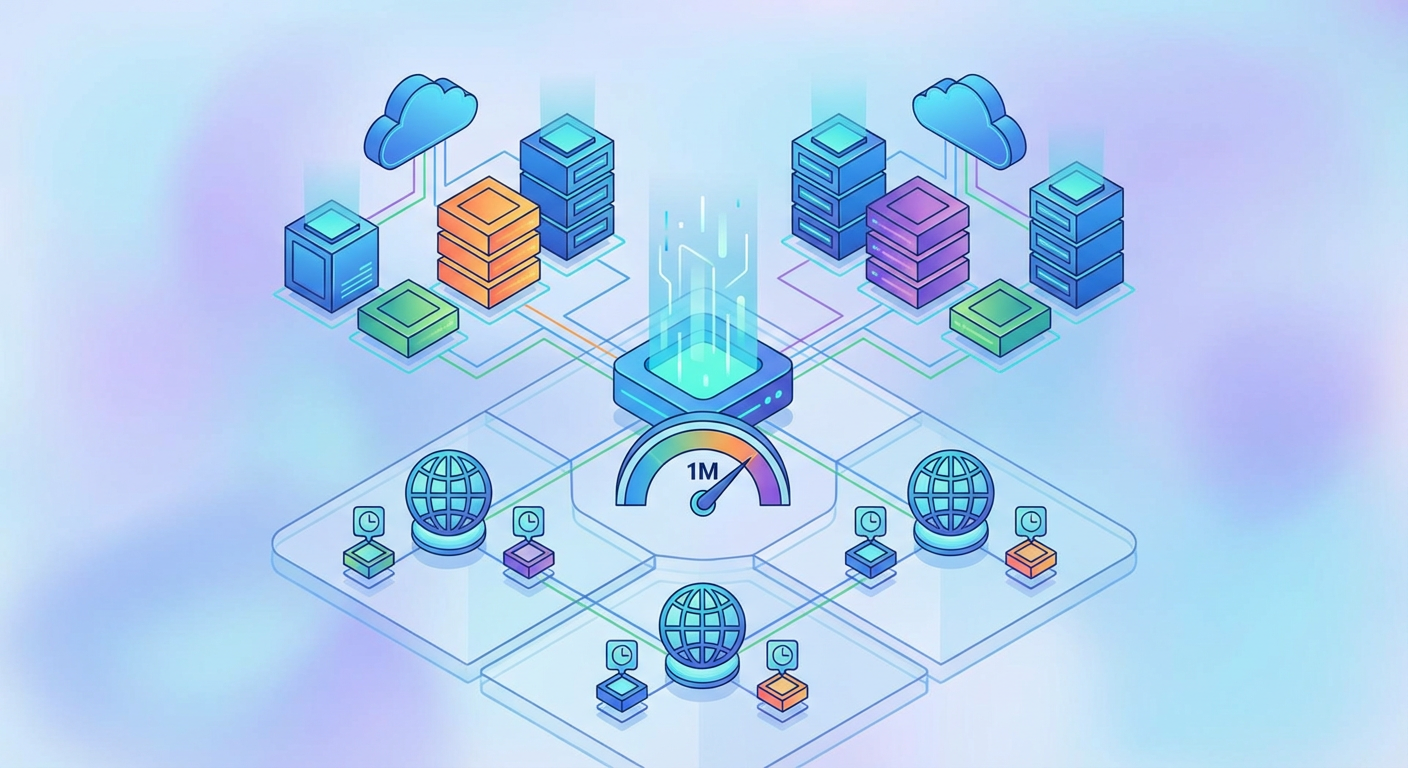
Aurora DSQL rewrites this entire equation. It uses an optimistic concurrency model and decouples storage from compute across availability zones. Writes aren’t serialized through a single region. Every region can accept writes simultaneously. The database handles conflict resolution at commit time, not at write time. Storage itself becomes a distributed layer, not a regionalized bottleneck.
The practical outcome: you eliminate read replica lag. That’s not theoretical. Cloudflare documented in their engineering blog that replica lag in Postgres-backed services caused latency spikes up to 180ms during peak traffic. With Aurora DSQL’s architecture, that problem doesn’t exist in the same form. All regions are active. All writes are durable across regions from the moment of commit.
This matters because it changes how you reason about global applications. You stop thinking about “primary” and “replica” regions. You think about “everywhere.” That’s a real mental model shift, and it cascades into simpler application code.
The Throughput Numbers and What They Actually Tell Us
AWS published internal benchmarks in late 2024 showing Aurora DSQL handling over 1 million transactions per second in multi-region configurations. Before you dismiss this as typical vendor math, consider what’s happening under the hood. That’s not a single region saturating. That’s multiple regions simultaneously processing transactions, with consistency guarantees intact. The number itself isn’t what matters. The consistency guarantees at that scale are.
Is that test representative of your workload? Maybe not. Benchmarks never are. But the fact that the database can hit that throughput without sacrificing correctness tells you something real about the engineering. The concurrency model doesn’t lock up. The storage layer doesn’t become a serialization point.
For most applications, the throughput ceiling won’t be the bottleneck anyway. The practical win is lower latency at consistent scale. If you’re running a SaaS product with users in three time zones, you can serve all of them with single-digit millisecond latencies without routing complexity.
Why This Matters Now: The Distributed SQL Market is Waking Up
This isn’t happening in isolation. Gartner flagged distributed SQL as a top-five infrastructure trend at their 2025 Data Management Summit. The market is projected to grow from $1.2 billion in 2024 to $4.8 billion by 2028. That’s not because vendors are marketing aggressively. That’s because companies are genuinely tired of global database problems.
Aurora DSQL enters a space with some established players, but AWS has one clear advantage: it ships with PostgreSQL compatibility built in. You don’t rewrite queries. You don’t learn a new dialect. You migrate a managed Postgres cluster and most of your application code works unchanged. That reduces friction by an order of magnitude compared to learning a completely new database system.
The other advantage is availability. AWS has the infrastructure footprint to make five-nines across regions a credible claim. Smaller vendors can’t match that without years of investment. When you’re betting infrastructure architecture on a technology, you need to trust that it’ll be supported and improved for a decade. AWS clears that bar.
Signal vs. Speculation: What We Know and What We’re Still Figuring Out
Let’s separate what we know from what we’re guessing at. Known: Aurora DSQL ships with PostgreSQL compatibility. That’s done. The optimistic concurrency model works at the throughput AWS demonstrated. That’s proven. Multi-region active-active without application-level routing complexity is real. Check the AWS Aurora DSQL documentation if you want the details on how to actually use it.
Still unclear: whether this solves every global database problem. It won’t. Applications with strict ordering requirements across regions still need thought. Transactions spanning multiple regions still have latency tradeoffs. Cost at scale is an open question, since AWS hasn’t published detailed pricing that accounts for multi-region replication bandwidth and distributed state management.
Ecosystem maturity is another unknown. ORM support will come, but it’ll take time. Connection pooling at scale with active-active regions requires rethinking. Observability tools will evolve. For the first eighteen months, you’re working closer to the metal than you might with standard Aurora.
If you want deeper context on AWS’s vision here, the Werner Vogels re:Invent 2024 keynote recap gives good color on how this fits into the broader distributed systems roadmap.
What This Actually Changes About How You Build
If you’re starting a new global application or migrating an existing one, Aurora DSQL changes the architecture conversation pretty significantly. You stop needing a cache layer for global read consistency. You stop building read-your-own-writes logic in your application. You stop designing around replica lag.
For teams managing complex multi-region PostgreSQL deployments, this points in a genuinely useful direction. Not “six months from now” useful. But “this is where infrastructure is heading” useful. The next time you’re designing a system that needs to serve users globally with consistent data, Aurora DSQL becomes a baseline option worth seriously evaluating.
The real test comes over the next twelve to eighteen months. Does the promise hold up in production at scale? Do customers actually migrate to it? Does the cost story make sense? These are the questions that separate real innovations from announcements.
If you’re building systems that span regions, read the documentation and run some benchmarks against your own workload. The signal is strong enough to warrant the time.
